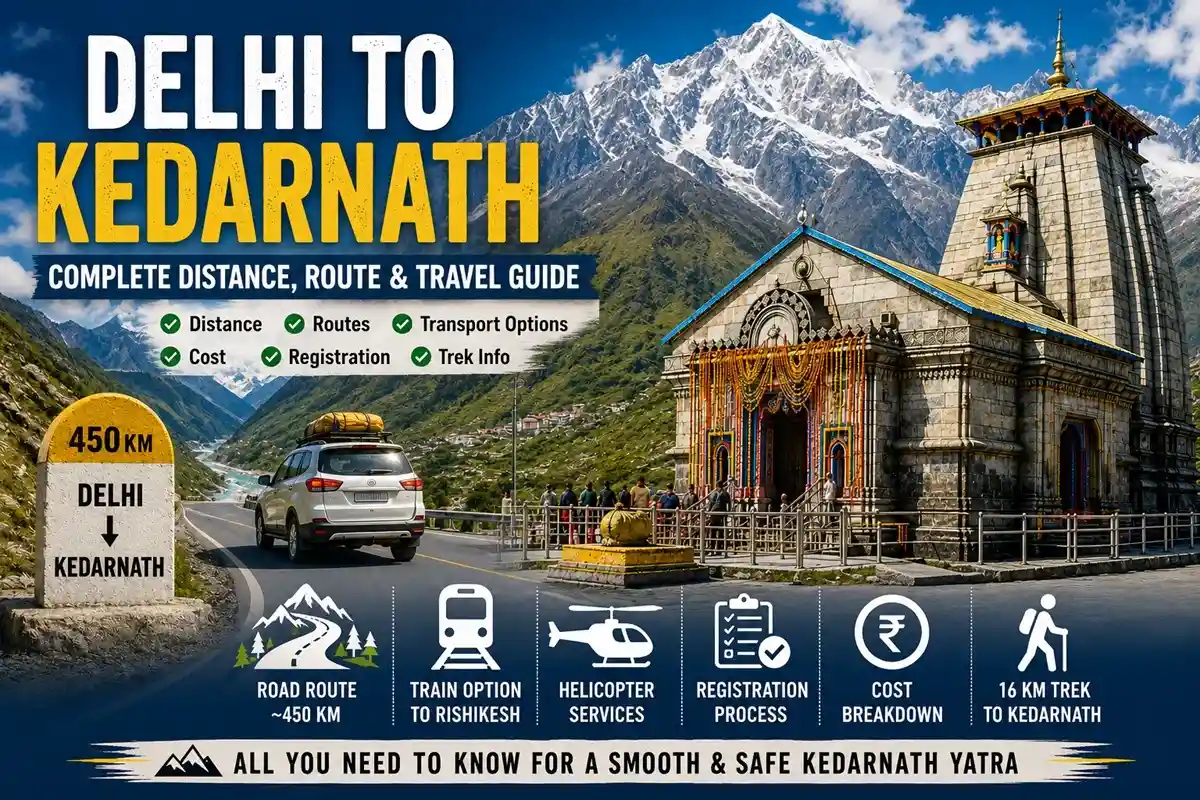
The Delhi to Kedarnath journey covers roughly 450 km by road up to the Sonprayag/Gaurikund area, followed by a 16 km trek to the temple at about 3,580 metres. Most pilgrims plan for 4–5 days round trip, whether they drive the whole stretch, combine a train ride to Rishikesh or Haridwar with a taxi, or fly the last leg by helicopter from Guptkashi, Phata, or Sirsi.
On the ground, the route itself is straightforward once you know where to halt. The tricky part is everything around it — registration, road conditions past Rudraprayag, where private cars are allowed to go, and how the trek changes depending on your fitness and the weather that week. This guide walks through all of it, the way we’d explain it to a family calling our office before booking.
| Quick Answer
Delhi to Kedarnath is approximately 450–470 km by road to the Sonprayag/Gaurikund area (roughly 13–16 hours’ driving, route and traffic dependent), plus a 16 km trek — or a short helicopter transfer from Guptkashi, Phata, or Sirsi — to reach the temple. Kedarnath opened for the 2026 season on 22 April at 8:00 AM and is expected to close around 11 November 2026, pending BKTC’s official confirmation. Registration on the official Uttarakhand Tourism portal (registrationandtouristcare.uk.gov.in) is mandatory before you travel, for road, trek, or helicopter, and it’s free. |
Latest Updates for the 2026 Kedarnath Yatra
A few things worth knowing before you plan your Delhi to Kedarnath trip this season:
- Char Dham Yatra 2026 opened on 19 April with Yamunotri and Gangotri; Kedarnath followed on 22 April, and Badrinath on 23 April.
- The official registration document list includes Aadhaar, voter ID, passport, or driving licence — keep Aadhaar details ready alongside one other valid photo ID, and check the portal for the exact requirement at the time you register.
- Additional offline counters were set up this year at Rishikesh and Haridwar to reduce queue time during peak season, alongside existing counters at Sonprayag and Gaurikund.
- Registration is verified through a QR-coded Yatra Registration Letter, checked at designated registration/verification points and at Dham entry.
- The route has seen temporary yatra suspensions this season during heavy-rainfall alerts — always check the official Tourist Care portal and local advisories before setting out, especially in the monsoon window.
Delhi to Kedarnath Distance: Route Breakdown
The route runs through Haridwar and Rishikesh, then follows the Char Dham all-weather road along the Alaknanda and Mandakini valleys via Devprayag, Srinagar, Rudraprayag, and Guptkashi. Here’s an approximate stretch-by-stretch breakdown:
| Route Segment | Distance | Approx. Time |
| Delhi to Haridwar | 215 km | 4–5 hrs |
| Haridwar to Rishikesh | 25 km | 45 min |
| Rishikesh to Devprayag | 70 km | 2 hrs |
| Devprayag to Rudraprayag | 70 km | 2.5 hrs |
| Rudraprayag to Guptkashi | 48 km | 1.5 hrs |
| Guptkashi to Sonprayag | 30 km | 1 hr |
| Sonprayag to Gaurikund | 5 km | 20–30 min (shared jeep only) |
| Gaurikund to Kedarnath (trek) | 16 km | 6–8 hrs |
These segment distances are approximate and vary with the exact route, diversions, and road conditions on the day. Adding them up puts the road distance to Gaurikund at roughly 450–460 km, with the official Uttarakhand Tourist Care portal separately listing Rishikesh–Kedarnath at about 220 km by road plus the 16 km trek, and Haridwar–Kedarnath at about 240 km by road plus the same trek.
One thing that surprises first-timers: private vehicles generally cannot go beyond Sonprayag. You park there and take an authorised local shuttle for the last 5 km to Gaurikund. Fares for this short stretch can change season to season, so confirm the current rate locally rather than relying on a fixed figure.
How to Reach Kedarnath from Delhi: Transport Options
1. By Road (Self-Drive or Taxi)
This is the most flexible option, and the one most families choose. A full non-stop drive from Delhi to Sonprayag takes roughly 13–16 hours depending on traffic near Meerut and road conditions past Rudraprayag. Breaking the drive into two days — with an overnight halt at Rishikesh or Rudraprayag — is generally easier than pushing through in one stretch, particularly for senior citizens or anyone prone to motion sickness on mountain curves.
- Own car: doable, but check tyre condition and carry a spare — mountain roads are unforgiving on worn tyres.
- Hired taxi/Innova: the common choice for families of 4–6; drivers know the halt points and checkpoints.
- Tempo Traveller: works well for groups of 8–12 travelling together.
- Bus: Uttarakhand Roadways and private operators run Delhi–Rishikesh services; you switch to a taxi from there.
2. By Train + Taxi
There’s no rail line into the mountains beyond Rishikesh — the official Tourist Care portal lists Dehradun, Haridwar, and Rishikesh as the nearest railway stations for Kedarnath. From Rishikesh, the road-plus-trek distance is about 220 km + 16 km; from Haridwar it’s about 240 km + 16 km. Both work the same way: take an overnight train from Delhi, then a taxi onward from the station.
The train doesn’t necessarily save time over a direct road trip — its main advantage is comfort. You sleep through the plains and start the mountain leg fresh in the morning, which can matter if you’re travelling with elderly parents or young children.
3. By Helicopter
For pilgrims short on time or unable to trek, helicopter shuttle services connect Guptkashi, Phata, and Sirsi to Kedarnath. Flight duration varies by helipad, weather, and operational load — generally a few minutes up to around 15–20 minutes. If you’re flying in from Delhi, you’d land at Dehradun’s Jolly Grant Airport (roughly 238 km from Kedarnath by most estimates, though figures vary 230–255 km across sources) and then continue by road to your chosen helipad — this is a substantial 7–9 hour mountain drive, not a short hop.
| Helipad | Round-Trip Base Fare (approx.) | Notes |
| Sirsi | ₹6,390 | Budget-friendly, fewer stay options nearby |
| Phata | ₹10,164 | Mid-range, central location |
| Guptkashi | ₹12,762 | Higher-altitude start, wider range of accommodation nearby |
These are base round-trip fares per the IRCTC HeliYatra 2026 notification; GST and a convenience/booking fee are added on top, so confirm the final payable amount on the booking page. Booking only happens through heliyatra.irctc.co.in — authorities have repeatedly warned pilgrims about fake booking websites and unauthorised agents, so treat any other site or agent asking for advance payment as a red flag.
Kedarnath Yatra Registration: What’s Mandatory in 2026
Registration on the official Uttarakhand Tourism portal, registrationandtouristcare.uk.gov.in, is compulsory for every pilgrim — whether you’re trekking, riding a pony, or flying in by helicopter. Helicopter operators usually complete this for you as part of the booking, but it’s worth confirming rather than assuming.
- Register online at registrationandtouristcare.uk.gov.in, or via the Tourist Care Uttarakhand app.
- Alternatively, send “Yatra” on WhatsApp to 8394833833, or call the toll-free helpline 0135-1364, to start registration.
- Enter travel dates, number of travellers, and which Dham(s) you’re visiting.
- Upload a valid photo ID — the portal’s accepted list includes Aadhaar, passport, voter ID, and driving licence. Keep your Aadhaar details handy alongside one of these, and check the exact requirement shown on the portal when you register.
- If you register offline, follow whatever additional verification the counter staff ask for on the day.
- Download and carry the QR-coded Yatra Registration Letter — it’s checked at designated registration/verification points along the route and at the Kedarnath entry gate.
Registration itself is completely free — it’s a separate, no-cost step from any helicopter, hotel, or transport booking you make. Offline counters exist at major halt points, including Sonprayag, Rishikesh, and Haridwar, but registering online in advance generally means shorter waits during peak season (May–June).
Gaurikund to Kedarnath Trek: What to Expect
The trek is 16 km one way, according to the current Uttarakhand Tourist Care portal, climbing from Gaurikund (commonly cited at around 1,980 m) to Kedarnath (about 3,580 m) — a gain of roughly 1,600 metres. It’s graded moderate to difficult: not technical, but long, and the altitude makes the final stretch genuinely tough for unprepared trekkers. Note that some older government and travel pages list slightly different figures (14–19 km) because route measurements have varied over time — 16 km is the figure the current official portal uses.
- On foot: 6–8 hours at a steady pace, per the official portal, more with frequent breaks.
- Pony/mule: available for hire at Gaurikund; duration depends on trail conditions and traffic on the day.
- Palki (palanquin): a carried option for those who can’t walk or ride.
- Helicopter: skips the trek entirely from Guptkashi, Phata, or Sirsi.
Start early. Weather at this altitude can change within hours — rain and cloud cover are common even in the May–June summer window — and trek timings can be revised on short notice for safety or crowd management. Check the same-day trek advisory at Gaurikund or Sonprayag before you set off, rather than assuming a fixed cut-off time.
Best Time to Travel Delhi to Kedarnath in 2026
| Period | Conditions | Suitable For |
| 22 Apr – mid-May | Cold, possible snow near temple, thinner crowds | Serious pilgrims, photographers |
| Late May – June | Clear roads, moderate crowds, warmer days | First-time visitors, families |
| July – Aug (monsoon) | Landslide risk, frequent road closures | Avoid unless unavoidable |
| Sept – mid-Oct | Stable weather, fewer crowds, good visibility | Trekkers, second-time visitors |
| Late Oct – 11 Nov | Very cold, Kapat closing season | Only for closing ceremony visits |
The Kapat for 2026 opens on 22 April at 8:00 AM, announced by the Badrinath-Kedarnath Temple Committee (BKTC) on Maha Shivratri, and closes tentatively around 11 November, confirmed on Vijayadashami. If your dates are flexible, late May to mid-June and September are the two windows we’d point most travellers toward — good weather without the peak-season crush.
Weather at Kedarnath & What to Pack
Kedarnath sits at about 3,580 metres, so weather shifts fast even within the same day. As a rough seasonal guide, May–June daytime temperatures often range 8–18°C, with nights and early mornings dropping closer to 0–9°C, and afternoon rain or cloud cover is common even outside the main monsoon. These are historical averages, not a forecast — check the IMD or the Tourist Care portal’s weather page for current conditions before you travel, since actual weather can vary significantly year to year.
- Thermal layers plus a windproof/waterproof outer jacket
- Sturdy trekking shoes with good grip, broken in before the trip — not new ones
- Rain poncho or umbrella, even in the “dry” months
- Woollen cap, gloves, and thick socks for early morning darshan
- Power bank, since charging points are scarce beyond Sonprayag
- Basic personal medication, ORS, and a doctor-approved altitude sickness tablet if you have a history of AMS
- Reusable water bottle and dry snacks for the trek
Where to Stay: Accommodation Options
Where you halt matters as much as how you travel. Here’s how the main stay points along the route relate to Kedarnath:
| Location | Relation to Kedarnath | Options |
| Guptkashi | Road-accessible base before Sonprayag | Wider range of hotels, budget to mid-range — a common overnight stop |
| Sonprayag | About 5 km by road from Gaurikund | Budget guesthouses and dharamshalas, convenient for an early trek start |
| Gaurikund | Start of the 16 km trek | Basic lodges with limited rooms — these fill up fast in peak season |
| Kedarnath (near temple) | Trek/helicopter destination | GMVN huts, dharamshalas, and tents — book well ahead for peak dates |
For many travellers, an overnight halt around Guptkashi makes the final push to Sonprayag and Gaurikund less rushed than trying to cover the whole route in one day from Delhi. It also builds in a buffer against traffic delays and a bit of time to acclimatise before altitude starts affecting you.
Indicative Delhi to Kedarnath Trip Cost (2026)
| Expense Head | Budget Estimate (per person) | Notes |
| Taxi/shared cab (round trip) | ₹4,000 – ₹8,000 | Depends heavily on group size, vehicle type, and season |
| Stay (2–3 nights, budget-mid) | ₹1,500 – ₹4,000/night | Guptkashi, Sonprayag, or Kedarnath |
| Pony/palki (one way) | ₹3,000 – ₹8,000 | Rates vary by season, demand, and exact route |
| Helicopter (round trip) | ₹6,390 – ₹12,762 base fare | Plus GST and convenience/booking fee |
| Food (per day) | ₹400 – ₹800 | Simple thali-style meals en route |
| Registration | Free | Mandatory, official portal only — separate from all paid services above |
These are indicative estimates, not fixed prices — actual costs vary by season, group size, vehicle category, and how far in advance you book. As a rough planning range, a shared-transport trip with budget stays can sometimes come in around ₹10,000 per person for the round trip, while a helicopter-based plan with mid-range hotels typically runs noticeably higher once taxes and fees are added.
Common Mistakes People Make
- Skipping online registration and getting turned back at Sonprayag without a valid registration letter.
- Driving overnight without a halt — fatigue on mountain curves is a real risk, not just discomfort.
- Booking helicopter tickets through unofficial websites or agents instead of heliyatra.irctc.co.in.
- Starting the trek late in the day and getting caught in afternoon weather changes.
- Packing only summer clothes for a May–June trip and underestimating night temperatures at altitude.
- Assuming private cars can go past Sonprayag — they can’t.
Safety Tips & Local Warnings
- Avoid the July–August monsoon window if you can — this stretch sees a higher risk of landslides and temporary road closures, and the yatra itself has been paused in past 2026 rain alerts.
- Watch for signs of altitude sickness (headache, nausea, breathlessness) on the trek and rest immediately if they appear — don’t push through.
- Mobile connectivity is unreliable on several mountain sections. Download offline maps and don’t rely solely on your phone for navigation or emergencies.
- Keep your registration letter and ID accessible at all times — verification points can ask for it without notice.
- Check the Tourist Care Uttarakhand weather and road-status pages on travel day, especially during and right after monsoon season.
- Stay on the designated trail and follow local administration instructions, particularly in sections prone to landslides.
Pro Tips for a Smoother Yatra
- Carry a printed and digital copy of your Yatra registration letter — network drops are common near Gaurikund.
- Layer clothing: daytime highs can fall sharply at night even in the May–June season.
- Book helicopter and stay well in advance during the May–June rush — slots fill fast once bookings open.
- Senior citizens and anyone with a heart or lung condition should consult a doctor before the trip and consider pony, palki, or helicopter over the full trek.
- A 2-night, 3-day plan with a halt at Guptkashi both ways tends to feel less rushed than trying to cover the whole route in a single push.
- Keep cash in small denominations for local shuttle and pony charges, which can vary by season.
Planning Your Trip
Coordinating registration, helicopter slots, halt bookings, and last-minute road advisories takes time, especially during peak season. If you’d rather not manage all of it yourself, a travel operator familiar with the current route and requirements can help put together an itinerary and handle the registration and booking steps.
Frequently Asked Questions
1. What is the distance from Delhi to Kedarnath?
The road distance from Delhi to Kedarnath is approximately 450–470 km up to the Sonprayag/Gaurikund area, the last motorable point. From there, it’s a 16 km trek, pony, or palki to reach the temple at about 3,580 metres. Helicopter travellers instead fly from a separate helipad — Guptkashi, Phata, or Sirsi.
2. How many days are needed for Delhi to Kedarnath yatra?
Most travellers need 4–5 days for a comfortable round trip — one day to reach Sonprayag or Guptkashi, one for the trek up, a day at Kedarnath, and two for the return journey. Helicopter travellers can compress this to 2–3 days.
3. Is there a direct train from Delhi to Kedarnath?
No. There’s no rail line into the mountains here. Dehradun, Haridwar, and Rishikesh are the nearest railway stations, per the official Tourist Care portal, with Rishikesh–Kedarnath at about 220 km by road plus the 16 km trek, and Haridwar–Kedarnath at about 240 km plus the trek.
4. Can I take my own car from Delhi to Kedarnath?
Yes, up to Sonprayag. Private vehicles are generally not permitted beyond that point — you’ll park there and take an authorised local shuttle for the final 5 km to Gaurikund. Confirm the current shuttle fare locally, as it can change.
5. What is the best time to travel from Delhi to Kedarnath in 2026?
Late May to mid-June and September to mid-October are the most favourable windows. Roads are stable, visibility is good, and crowds are thinner than the immediate post-opening rush in late April.
6. How much does the Delhi to Kedarnath trip cost?
It varies a lot by season, group size, and travel mode. As a rough guide, a shared-transport trip with budget stays can sometimes come in around ₹10,000 per person round trip, while adding a helicopter leg and mid-range hotels pushes the total noticeably higher once GST and fees are included.
7. Is helicopter booking mandatory to skip the trek?
No, it’s optional. The 16 km trek, pony, and palki are all valid alternatives. Helicopter service simply saves time and physical effort, and is popular with senior citizens and those with limited days off.
8. Is Char Dham Yatra registration compulsory for Kedarnath?
Yes, registration is mandatory for every pilgrim regardless of travel mode — road, trek, or helicopter. It’s free and can be completed online through the official Uttarakhand Tourism portal or the Tourist Care Uttarakhand app.
9. What is the trek difficulty level from Gaurikund to Kedarnath?
It’s rated moderate to difficult. The 16 km distance itself isn’t extreme, but the roughly 1,600-metre altitude gain makes the final stretch tiring, especially for those not acclimatised or unused to long walks.
10. When does Kedarnath open and close in 2026?
Kedarnath opened for the 2026 season on 22 April at 8:00 AM. The temple is expected to close around 11 November 2026, though BKTC’s final closing announcement, usually made closer to the date, should be treated as the confirmed word.
11. Which is the nearest airport to Kedarnath from Delhi?
Jolly Grant Airport in Dehradun is the nearest airport, roughly 238 km from Kedarnath (estimates range 230–255 km by source), connected to Delhi by daily flights. From there, it’s a substantial 7–9 hour road journey to Guptkashi, Phata, or Sirsi to continue by taxi or helicopter — not a short drive.
12. Do senior citizens need any special preparation for this trip?
Yes. A short acclimatisation halt at Guptkashi, warm layered clothing, and preferring pony, palki, or helicopter over the full trek are strongly recommended given the altitude and cold.
13. Is Aadhaar mandatory for Kedarnath Yatra registration?
The official portal’s accepted ID list includes Aadhaar, voter ID, passport, and driving licence. Keep your Aadhaar details ready alongside one other valid photo ID, and check the exact requirement shown on the portal at the time you register.
14. What should I pack for a Delhi to Kedarnath trip?
Thermal layers, a waterproof jacket, sturdy broken-in trekking shoes, a rain poncho, woollen cap and gloves, and a power bank. Nights stay cold even in the May–June season, so warm layers matter more than travellers expect.
15. How far is Gaurikund from Sonprayag, and why does it matter?
About 5 km. This is the stretch where private vehicles stop and pilgrims switch to an authorised local shuttle — it’s a common source of confusion for first-time visitors who assume they can drive straight to the trek starting point.
Conclusion: Planning Your Delhi to Kedarnath Journey
The Delhi to Kedarnath route isn’t complicated once you break it into stages — Delhi to Rishikesh, Rishikesh to Guptkashi, and Sonprayag to Gaurikund, followed by the final trek or flight. What actually decides whether the trip feels smooth or stressful is preparation: registering early, booking helicopter or stays before the peak-season rush, and building in a halt instead of pushing through in one go.
A 4–5 day plan with a halt at Guptkashi tends to work well for first-timers and families. Travellers on a tighter schedule can manage it in 2–3 days by combining an overnight drive with the helicopter leg. Either way, booking early is worth doing once the May–June rush begins — slots for stays and helicopter tickets fill up fast.
Planning your Kedarnath Yatra from Delhi? Get in touch with our team for help with itinerary planning, registration, and helicopter or road bookings for 2026.