

Planning your Yamunotri Yatra and not sure where to start? You’re not alone. Every year, lakhs of pilgrims from across India — and many from abroad — head toward this sacred Himalayan shrine, most of them arriving underprepared. Wrong shoes. No registration done. No idea about the trek. And then they’re stuck at Janki Chatti wondering what to do next.
This guide covers everything from scratch — history, opening dates, how to reach, trek details, cost breakdown, accommodation, best time, and the little things that nobody tells you but matter most.
What Is Yamunotri and Why Does It Matter?
Yamunotri is the sacred source of the Yamuna River and one of the four revered sites of the Char Dham Yatra in Uttarakhand, dedicated to Goddess Yamuna. It sits deep in the Garhwal Himalayas at an altitude of 3,293 meters (10,804 feet), surrounded by snow-capped peaks, dense forests, and the thundering sound of the river below.
In Hindu tradition, Yamuna Devi is the daughter of Surya (the Sun God) and the sister of Yama (the God of Death). According to legend, taking a holy dip in Yamunotri and offering prayers to the goddess ensures protection from untimely death and grants peace of mind.
The temple was originally built in the 19th century by Maharani Guleria of Jaipur and later reconstructed by Maharaja Pratap Shah. The sacred shrine is situated near the source of the Yamuna River, one of the major rivers in India.
Yamunotri is always the first stop in the Char Dham circuit — the route goes Yamunotri → Gangotri → Kedarnath → Badrinath. Starting here isn’t just tradition. It’s also geographically logical, moving from west to east across Uttarakhand.
Opening & Closing Dates
This is the most searched question — and it changes every year based on the Hindu Panchang.
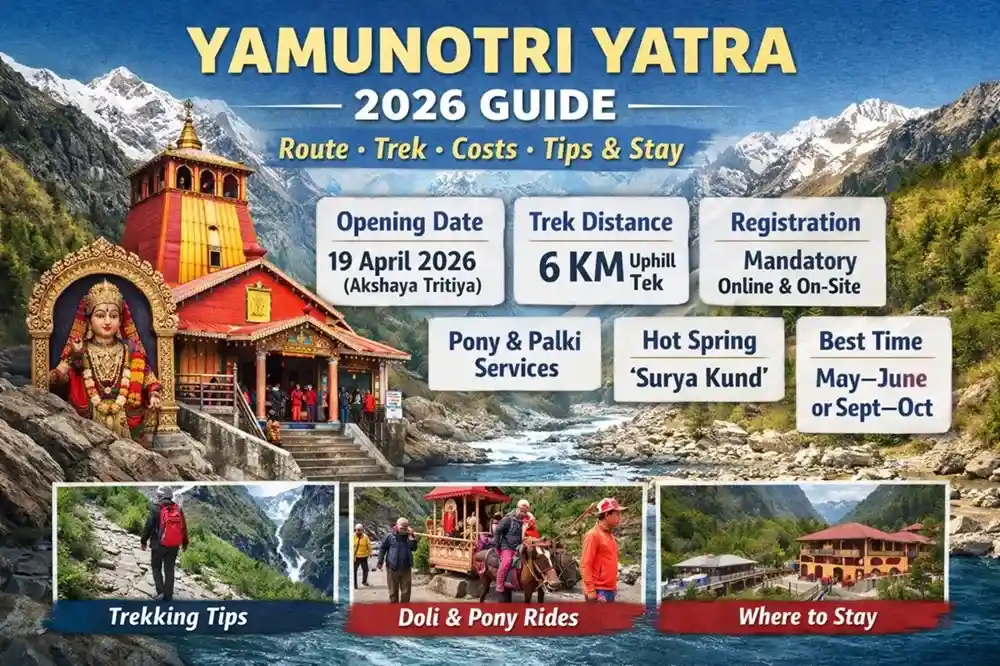
The portals of Yamunotri Dham are set to open for pilgrims on 19 April 2026 on the auspicious day of Akshaya Tritiya.
For reference, in 2025 the temple opened on April 30 and closed on November 1.
The Yamunotri Temple closes around Diwali/Bhai Dooj every year. The idol of Goddess Yamuna is placed in a palanquin and carried to Kharsali Village — her winter home — and the temple doors are sealed until the next season.
| Year | Opening Date | Closing Date |
|---|---|---|
| 2025 | April 30, 2025 (Akshaya Tritiya) | November 1, 2025 (Bhai Dooj) |
| 2026 | April 19, 2026 (Akshaya Tritiya) | ~Late October / Bhai Dooj |
Note: Closing dates for 2026 are not officially declared yet. Monitor the Uttarakhand Tourism portal for updates closer to the season.
Yamunotri Dham Darshan Timings
Yamunotri Dham Darshan is open from 6:00 AM to 8:00 PM during the yatra season.
Practically speaking, arriving for the morning aarti (around 6–7 AM) is the best experience. The temple isn’t as crowded, the air is crisp, and the chanting feels different in the early mountain light. Peak hours are typically 10 AM to 2 PM — that’s when most day-trekkers from Janki Chatti arrive.
How to Reach Yamunotri — Complete Route Guide
This is where a lot of pilgrims get confused. Yamunotri is not directly connected by rail or air. You have to combine modes of transport.
Step 1: Reach Dehradun or Rishikesh
By Air: The nearest airport is Jolly Grant Airport in Dehradun, approximately 210 km from Yamunotri. Flights connect from Delhi, Mumbai, and Bengaluru regularly.
By Train: The nearest railway station is Dehradun (175 km). Rishikesh Railway Station is another option — slightly closer to the starting point of the road journey.
By Bus: Buses run from Delhi’s ISBT Kashmere Gate to Dehradun and Rishikesh throughout the day. UPSRTC and Uttarakhand Roadways are the main operators.
Step 2: Dehradun / Rishikesh → Barkot (via Mussoorie or Vikasnagar)
This is a 170–190 km road journey and takes 6–8 hours depending on traffic and road conditions. The route passes through Mussoorie, Kempty Falls, and Barkot — the main base town for Yamunotri.
Most pilgrims spend a night at Barkot or Syanachatti to acclimatize before heading to the trailhead.
Step 3: Barkot → Janki Chatti (last motorable point)
From Barkot, it’s roughly 40–45 km to Janki Chatti. The trek to Yamunotri temple begins from Jankichatti — Yamunotri is 6 km from Jankichatti.
Shared jeeps and local taxis ply this stretch regularly during the yatra season.
Full Route Map
| Segment | Distance | Mode | Approx. Time |
|---|---|---|---|
| Delhi → Dehradun/Rishikesh | 280–300 km | Train / Bus / Car | 5–6 hours |
| Dehradun → Barkot | 180 km | Road (Taxi/Bus) | 6–7 hours |
| Barkot → Janki Chatti | 40 km | Shared Jeep / Taxi | 1.5 hours |
| Janki Chatti → Yamunotri Temple | 6 km | Trek / Pony / Palki | 2–4 hours |
Helicopter Option
Helicopter services from Dehradun (Sahastradhara helipad) to Kharsali are available, making the journey easier for those who cannot manage the trek. From Kharsali, it’s a short walk or pony ride to the temple. Helicopter bookings should be made well in advance, especially for May and June.
Yamunotri Trek
A lot of guides call this trek “easy.” That’s a bit misleading.
The trek from Janki Chatti to Yamunotri is 6 km in distance. It takes about 4 hours for the uphill journey and 2 hours for the downhill return. The difficulty level is considered moderate — even beginners and fit senior citizens can undertake it. The path is paved with stones, and there’s no technical climbing involved. However, the last two kilometres have a steep ascent.
You can enjoy several tea shops and resting places along the route. The trail passes through conifer forests, rhododendron trees, and alongside gushing Himalayan streams. In May, wildflowers dot the path. In October, the trees turn gold and amber.
What actually slows people down:
- The altitude. 3,293 meters hits differently if you’ve come straight from the plains.
- The last 2 km steep climb. This is where the pony traffic is heaviest too, so the path can get narrow and a bit chaotic.
- The cold. Even in May, temperatures drop sharply by 3 PM.
Trekking Tips (from ground experience):
- Start your uphill no later than 8 AM. Come down before 3 PM to avoid cold and low light.
- Stay hydrated. Carry at least 1.5 litres of water.
- Wear proper trekking shoes with ankle support. Sneakers aren’t good enough on the stone path.
- Keep a light daypack. Leave heavy bags at your lodge in Janki Chatti.
- Walk on the pilgrim side of the path, not on the pony track.
Pony, Palki, and Doli Services: Rates & Booking
Can’t do the full trek? No problem. These services have been running for generations.
Pony/Palki charges for Yamunotri: pony prices can be ₹800–₹1,500 one way; Palki/Doli rates start from ₹3,000 and go up to ₹4,500. During peak months (May–June), rates tend to be higher.
Doli for senior citizens costs ₹6,000–₹10,000 — ideal for elderly yatris who need a comfortable way to reach the temple.
| Service | One Way Rate (Approx.) | Best For |
|---|---|---|
| Pony | ₹800–₹1,500 | Adults, fit seniors |
| Palki (Palanquin) | ₹3,000–₹4,500 | Those unable to trek |
| Doli (Senior) | ₹6,000–₹10,000 | Elderly pilgrims |
Pilgrims can book pony and doli services directly at Janki Chatti, where there are dedicated booking counters. During peak season, advance booking at the counter in the morning is recommended.
Important: Never pay anyone on the trail itself without a receipt from the prepaid counter. Overcharging happens. Always use the official counter at Janki Chatti.
Key Attractions at Yamunotri
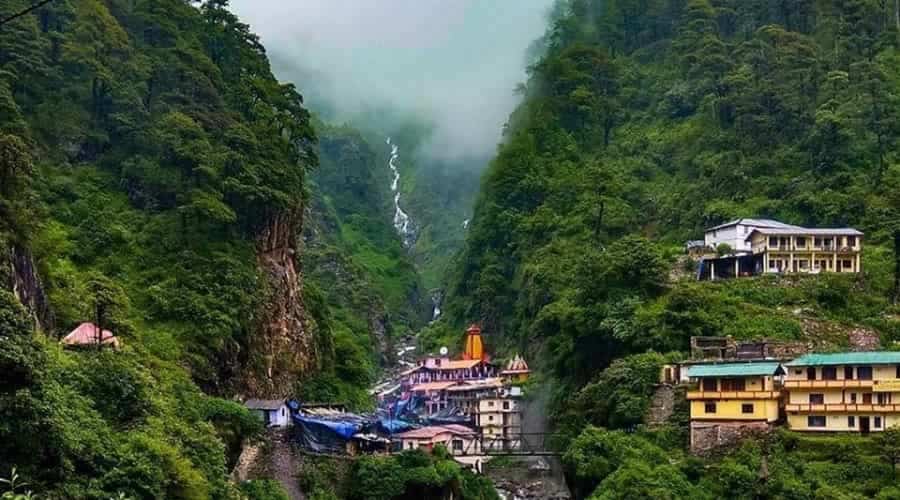
1. Yamunotri Temple
The heart of the pilgrimage. The main idol of Goddess Yamuna is a beautiful silver deity decorated with garlands and flowers. The sanctum is small, so darshan is quick but intensely devotional. Photography is generally not permitted inside the sanctum sanctorum.
2. Surya Kund
Surya Kund is a hot water spring near the temple, ideal for cooking rice as a prasad (offering) to the deity. Pilgrims bring raw rice and potatoes wrapped in cloth, dip them in the boiling spring water, and take the cooked food home as prasad. The water here reaches close to boiling point — be careful and follow the temple guidelines.
3. Divya Shila
Devotees also pay respect to Divya Shila, a rock pillar just before entering the Yamunotri temple. It’s considered sacred, and most pilgrims offer flowers and prayers here before proceeding to the main temple.
4. Janki Chatti and Hanuman Chatti
These aren’t just transit points — they’re beautiful Himalayan villages worth a slow morning walk. Janki Chatti has basic but charming dharamshalas, small dhabas serving hot chai and paranthas, and the constant sound of the river below.
5. Kharsali Village
This quiet village on the other side of the mountain is where the idol of Goddess Yamuna rests during winter. It has a beautiful Shani Dev temple. If you’re visiting during off-season or want a less-crowded spiritual experience, Kharsali is worth a detour.
Yamunotri Yatra Cost Breakdown: Budget to Luxury
Here’s a realistic budget if you’re planning independently from Rishikesh or Haridwar:
| Expense Head | Budget Option | Mid-Range | Comfortable |
|---|---|---|---|
| Transport (Rishikesh → Janki Chatti return) | ₹800–₹1,200 (bus) | ₹2,500–₹4,000 (shared taxi) | ₹6,000–₹10,000 (private cab) |
| Accommodation (per night, Barkot or Janki Chatti) | ₹400–₹800 (dharamshala) | ₹1,200–₹2,500 (guesthouse) | ₹3,000–₹6,000 (resort) |
| Meals (per day) | ₹200–₹400 | ₹500–₹800 | ₹1,000+ |
| Trek (self) | ₹0 | ₹0 | ₹0 |
| Pony/Palki (optional) | — | ₹800–₹1,500 (pony) | ₹3,000–₹4,500 (palki) |
| Prasad, Pooja | ₹100–₹300 | ₹300–₹800 | ₹1,000+ |
| Estimated 3-day total (per person) | ₹3,000–₹5,000 | ₹8,000–₹15,000 | ₹20,000–₹35,000 |
If you book a full Char Dham Yatra package: Budget packages start from ₹22,000–₹30,000 per person (shared transport, basic hotels, vegetarian meals). Deluxe packages range between ₹35,000–₹70,000. Luxury or helicopter packages can exceed ₹1,00,000–₹2,20,000 per person.
Where to Stay Near Yamunotri
Barkot is the most comfortable base. It’s a proper small town with a range of hotels, good mobile connectivity (BSNL works best in the mountains), ATMs, and medical facilities.
Janki Chatti has basic dharamshalas and lodges. GMVN (Garhwal Mandal Vikas Nigam) operates a Tourist Rest House here — clean, affordable, and government-run. Booking in advance is strongly recommended for May and June.
Syanachatti is a quieter alternative between Barkot and Janki Chatti — peaceful, less crowded, and growing in popularity.
Kharsali offers a handful of homestays for those wanting an off-the-beaten-path experience.
GMVN properties can be booked online at gmvnl.in. During peak season (May 15–June 15), even GMVN properties fill up fast. Book at least 2–3 weeks ahead.
Best Time to Visit Yamunotri
May–June (Peak Season, Best Weather)
This is when the mountains are at their most alive. Wildflowers bloom on the trek, the air smells fresh, and the sky is often clear blue. Temperatures range from 10°C to 18°C during the day.
The downside: It’s crowded. Very crowded. Long queues at the temple. Pony prices are higher. Book everything in advance.
September–October (Post-Monsoon, Fewer Crowds)
September and October offer less crowded conditions but colder temperatures. The landscape after the monsoon is lush and green, waterfalls are in full flow, and you’ll often have the temple almost to yourself on weekday mornings.
The downside: Temperatures at night can drop to near zero by late October. Carry full winter gear.
Avoid: July–August (Monsoon)
This is the most common mistake people make. The roads near Barkot and Janki Chatti are narrow mountain roads. During monsoon, landslides are frequent and unpredictable. Tourists and pilgrims should inquire about weather and road conditions before planning their visit — incessant rains often block the roads and disrupt traffic. Several yatris get stranded mid-journey every year in this period.
| Month | Weather | Crowd | Recommendation |
|---|---|---|---|
| May | 10°C–18°C day | Very High | ✅ Best but book early |
| June | 8°C–15°C day | High | ✅ Good choice |
| July–August | Rains | Low | ❌ Avoid (landslides) |
| September | 7°C–14°C day | Medium | ✅ Ideal for trekkers |
| October | 5°C–12°C day | Low | ✅ Peaceful, carry warm clothes |
Char Dham Registration
Registration is mandatory and can be done online via the Uttarakhand Tourism website or at designated centers in Haridwar and Rishikesh.
The Uttarakhand government introduced mandatory biometric registration for Char Dham pilgrims after the 2013 Kedarnath tragedy. It helps the government track pilgrims and respond faster in emergencies.
How to register:
- Visit the official portal: registrationandtouristcare.uk.gov.in
- Fill in personal details, travel dates, and dham sequence
- Upload Aadhaar or any government ID
- Download and print (or save) your registration slip
- Carry it throughout the yatra — checkpoints will verify it
On-site registration counters are also available at Haridwar, Rishikesh, and Barkot. But doing it online before you travel saves time and stress.
What to Pack for Yamunotri Yatra: The Real List
Most lists online are copy-pasted. Here’s what actually matters on the ground:
Clothing:
- Thermal inner layers (non-negotiable even in May)
- A windproof jacket
- Waterproof/rain poncho (sudden showers happen even in June)
- Warm socks — at least 3 pairs
- Trekking shoes with ankle support (not sneakers, not sandals)
- Cap/beanie for cold mornings
Health & Safety:
- Diamox (altitude sickness tablets) — consult your doctor before
- Crepe bandage (for ankle sprains on the stony path)
- ORS sachets (dehydration is real at altitude)
- Personal medicines + extra supply
- Sunscreen (UV intensity is high at altitude)
- Lip balm
Documents & Essentials:
- Aadhaar card / government ID (multiple checkpoints)
- Char Dham registration slip
- Cash — ATMs at Barkot, but nothing beyond. Janki Chatti is mostly cash-only
- Power bank (power cuts are common in mountain guesthouses)
- Torch/headlamp
Mistakes to Aovide
These come up year after year:
- Starting the trek too late. If you leave Janki Chatti after 10 AM, you’ll be returning in the dark or cold. Start at 7–8 AM.
- Skipping acclimatization. Coming directly from the plains to 3,293 meters in one day causes headaches, nausea, and breathlessness. Spend a night at Barkot or Syanachatti before trekking.
- Not carrying enough cash. The ATM at Barkot often runs out during peak season. Carry enough before you leave Rishikesh.
- Trusting random pony operators on the trail. Always book from the official prepaid counter at Janki Chatti.
- Going in July–August without checking conditions. Landslide news from this stretch rarely makes national headlines. Check the district disaster management Twitter handles or local news the night before you travel.
- Ignoring the return journey time. The downhill trek still takes 1.5–2 hours. And road travel from Janki Chatti back to Barkot after 5 PM in October means driving on mountain roads in the dark. Not ideal.
Safety Tips for the Yamunotri Yatra
In real life, the mountains demand respect. These aren’t scare tactics — they’re things that experienced pilgrims learn the hard way.
- Travel experts recommend acclimatizing at Barkot or Syanachatti a day before your trek. Even one night at a middle altitude makes a genuine difference.
- Avoid trekking post 3 PM. Weather in the Himalayas changes within minutes.
- Night travel on mountain roads is not recommended. Night travel during Char Dham Yatra is not allowed by Uttarakhand Police.
- If anyone in your group shows signs of severe altitude sickness — confusion, loss of balance, bluish lips — descend immediately. Don’t wait.
- Keep emergency numbers saved: Uttarakhand Tourism Helpline: 1364, SDRF (State Disaster Response Force): 112
- Inform your family or a local contact about your daily travel plan.
Yamunotri Yatra Itinerary: 3-Day Plan from Rishikesh
This is the most practical itinerary for most pilgrims.
Day 1: Rishikesh → Barkot (190 km, 7–8 hours)
- Depart by 6 AM from Rishikesh
- Stop at Mussoorie or Kempty Falls (optional)
- Reach Barkot by 2–3 PM
- Check in, rest, explore the small market
- Dinner and early sleep (important — you have a trek tomorrow)
Day 2: Barkot → Janki Chatti → Yamunotri → Janki Chatti
- Depart Barkot by 6 AM, reach Janki Chatti by 8 AM
- Begin trek at 8 AM; reach Yamunotri by 11 AM–12 PM
- Darshan, Surya Kund, Divya Shila puja
- Cook prasad at Surya Kund
- Begin descent by 1–2 PM; reach Janki Chatti by 3–4 PM
- Overnight at Janki Chatti or drive back to Barkot
Day 3: Return to Rishikesh / Continue to Uttarkashi for Gangotri
- If doing only Yamunotri: drive back to Rishikesh (6–7 hours)
- If doing Char Dham: proceed to Uttarkashi (3–4 hours from Barkot)
Frequently Asked Questions (FAQs)
Q1: Is the Yamunotri trek difficult for senior citizens?
Not impossible, but it needs preparation. The difficulty level is moderate, and even fit senior citizens can undertake it. The pony and palki services make it accessible. Spend an extra day at Barkot for acclimatization.
Q2: Can I visit Yamunotri without doing the full Char Dham?
Absolutely. Thousands of pilgrims visit only Yamunotri each year. It’s a standalone pilgrimage in its own right.
Q3: Is there mobile network at Yamunotri?
BSNL is the most reliable network on this route. Airtel works intermittently in Barkot and Janki Chatti. At the Yamunotri temple itself, there’s no network. Download offline maps before you travel.
Q4: Are there any medical facilities on the route?
Basic health posts are set up by the Uttarakhand government at Janki Chatti during the yatra season. For serious emergencies, the nearest hospital is in Uttarkashi. Carry personal medicines and a first aid kit.
Q5: What is the best way to cook prasad at Surya Kund?
Bring rice or potatoes in a cloth pouch. Tie the pouch tightly and immerse it in the hot spring water near the kund. The water is very hot — temple staff or locals will show you the right spot. The cooking takes about 15–20 minutes.
Q6: Can I visit Yamunotri in October?
Yes, and it’s actually beautiful in October. Large numbers of devotees visit this shrine during the months of May to October. Carry adequate warm clothing — nights can get below 5°C by mid-October.
Q7: How far is Yamunotri from Rishikesh?
Approximately 220–240 km by road. It takes 7–8 hours depending on road conditions and stops.
Q8: Is it safe to travel during early May (right after the opening)?
Yes, generally. But some high-altitude stretches may still have snow in late April. After the first week of May, the route is usually fully clear. Check road conditions at the Uttarkashi district disaster management portal before traveling.
