If you’re planning the Haridwar to Badrinath trip and feel overwhelmed by conflicting information online — route options, registration confusion, costs, what to pack — this guide is for you. No fluff. No recycled content. Just practical, accurate, updated-for-2026 guidance that will help you plan a smooth and spiritually meaningful yatra.
Badrinath is the final and most sacred dham of the Char Dham Yatra circuit. Dedicated to Lord Vishnu in his meditative form, the temple sits at 3,133 metres in the Garhwal Himalayas along the banks of the Alaknanda River. What most people don’t realize is that Haridwar — literally the “Gateway to God” — is not just a convenient starting point. It’s the most well-connected rail and road hub for the entire yatra, making it the natural launch point for most pilgrims.
The road distance from Haridwar to Badrinath is approximately 320 km, and it takes 10 to 12 hours of driving. Unlike Kedarnath, no trekking is required. Vehicles can drive all the way to the temple town itself — making Badrinath accessible to senior citizens, families with young children, and anyone who can’t manage a long trek.
2026 Temple Opening Date – Mark This First
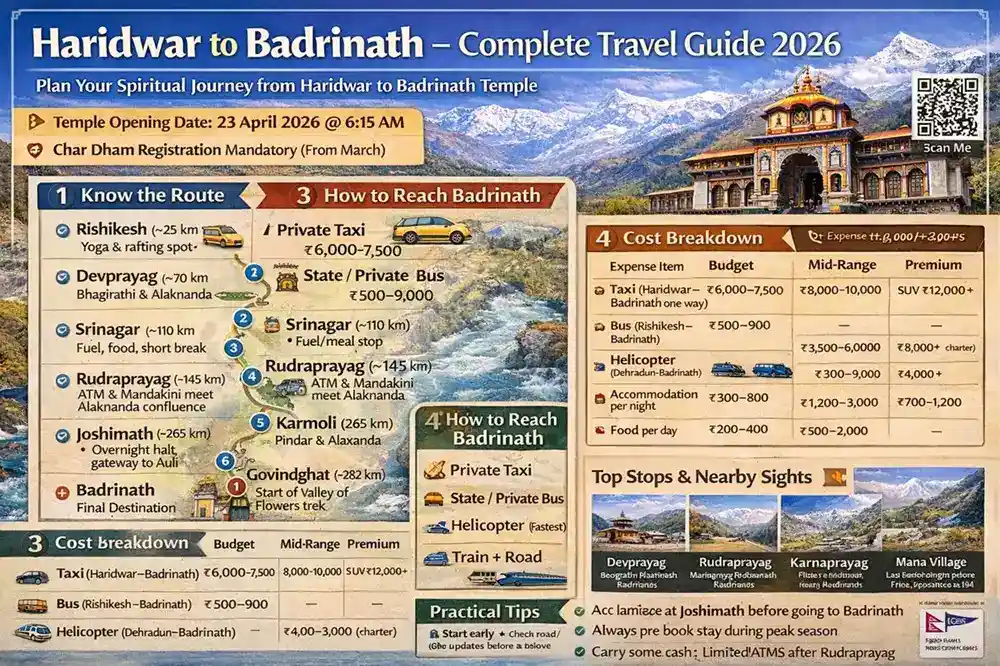
The Badrinath Temple opening date 2026 is confirmed for 23 April 2026 at 6:15 AM. This date was officially announced on Basant Panchami (23 January 2026) following traditional astrological calculations performed at the Royal Palace of the Tehri Garhwal family in Narendranagar.
The tentative closing date for Badrinath in 2026 is November 13, 2026, though the exact date will be declared on Vijayadashami (Dussehra).
Note that the Badrinath temple remains closed between 12:00 PM and 3:00 PM every day. Daily darshan timings are approximately 4:30 AM to 1:00 PM and 4:00 PM to 9:00 PM.
The first few days after opening draw massive crowds. Opening week usually sees high devotional turnout, especially from pilgrims who specifically wait for the first darshan — expect waiting times of 1–2 hours in the first few days. By mid-May, crowd flow becomes more manageable.
Haridwar to Badrinath: The Route at a Glance
The journey winds through key locations like Rishikesh, Devprayag, Srinagar, Karnaprayag, Joshimath, and Govindghat before reaching the sacred town of Badrinath.
| Checkpoint | Distance from Haridwar | Key Notes |
|---|---|---|
| Rishikesh | ~25 km | Yoga capital, more transport options than Haridwar |
| Devprayag | ~70 km | Bhagirathi–Alaknanda confluence |
| Srinagar (Garhwal) | ~110 km | Fuel, food, short break |
| Rudraprayag | ~145 km | Last reliable ATM; Mandakini–Alaknanda confluence |
| Karnaprayag | ~175 km | Alaknanda–Pindar confluence |
| Chamoli | ~215 km | Small town; check road conditions here |
| Joshimath | ~265 km | Ideal overnight halt; gateway to Auli |
| Govindghat | ~282 km | Trailhead for Valley of Flowers trek |
| Badrinath | ~320 km | Temple town; vehicles reach right up |
Start before 6 AM from Haridwar. The mountain roads narrow considerably after Rudraprayag, and afternoon hours bring more traffic, especially during peak season.
How to Reach Badrinath from Haridwar: All Your Options
Option 1: Private Taxi (Most Recommended)
For families, senior citizens, and pilgrims who value comfort and flexibility, a private taxi is the best way to cover the Haridwar to Badrinath distance. You can stop at confluences, eat at roadside dhabas, and adjust pace according to your group’s needs.
The fare for a one-way Innova or similar SUV runs between ₹7,000 and ₹10,000 depending on the vehicle type and season. Round-trip packages from Haridwar to Badrinath cost ₹14,000 to ₹20,000 for the full journey.
Book through registered operators at Haridwar bus stand or online travel platforms. Always confirm the driver has a valid hill-route permit.
Option 2: State/Private Bus
Travelling by bus is the most economical way to make this journey. Pilgrims can use government and private buses operating on the Haridwar–Badrinath corridor. GMOU and UTSRTC (Uttarakhand Transport Corporation) run state buses from Rishikesh Bus Stand (25 km from Haridwar) that go up to Badrinath directly during yatra season.
Bus fares range from ₹500 to ₹900 one way. Buses typically depart early morning between 4:30 AM and 7:00 AM. Travel time is longer — 12 to 14 hours — due to stops and slower pace on hill roads.
Shared jeeps from Rishikesh to Joshimath and onward are also widely available, often faster than buses and cheaper than taxis.
Option 3: Helicopter (Fastest)
There is no direct helicopter route from Haridwar to Badrinath, but the nearest airport is Jolly Grant Airport in Dehradun (35 km from Haridwar), from where helicopter services to Badrinath are available seasonally.
Helicopter service for Badrinath was introduced during the Char Dham Yatra 2025 from Jolly Grant Airport, reducing overall travel time significantly. Book through the official IRCTC portal (heliyatra.irctc.co.in). The heli ride itself takes around 45 to 60 minutes. Fares typically range from ₹3,500 to ₹6,000 one way.
Option 4: By Train to Haridwar, Then Road
There is no direct train to Badrinath — the nearest railway stations are Haridwar and Rishikesh. Haridwar railway station is extremely well connected to Delhi, Mumbai, Ahmedabad, Varanasi, and most major Indian cities. From Haridwar station, hire a taxi or board a bus directly to Badrinath.
Cost Breakdown: Haridwar to Badrinath Trip Budget 2026
Planning your budget before leaving saves a lot of stress on the road.
| Expense Item | Budget Option | Mid-Range | Premium |
|---|---|---|---|
| Taxi (Haridwar–Badrinath one way) | ₹6,000–7,500 | ₹8,000–10,000 | SUV ₹12,000+ |
| Bus (Rishikesh–Badrinath) | ₹500–900 | — | — |
| Helicopter (Dehradun–Badrinath) | — | ₹3,500–6,000 | ₹8,000+ (charter) |
| Accommodation per night | ₹300–800 (dharamshalas) | ₹1,200–3,000 | ₹4,000+ |
| Food per day | ₹200–400 | ₹400–700 | ₹700–1,200 |
| Puja & darshan offerings | ₹200–500 | ₹500–2,000 | ₹2,000+ (VIP) |
| Miscellaneous (tolls, ponies, porter) | ₹200–500 | ₹500–1,000 | — |
A modest Haridwar to Badrinath trip for two people — covering travel, two nights, food, and basic darshan — can cost between ₹8,000 and ₹16,000. Helicopter-based premium yatra packages can run ₹25,000 to ₹50,000 per person.
Best Time to Visit Badrinath from Haridwar
The best time to visit Badrinath by road is during the summer months of April to June and the autumn months of September to November — when the weather is clear and roads are in good condition.
Late April – June (Peak Season, Best Conditions)
The temple has just opened. Roads are clear of snow. Temperatures are cold in the mornings (2°C to 8°C at Badrinath) but manageable. Expect the highest crowds, especially in May. Book accommodation at least 2–3 weeks in advance.
July – August (Monsoon – Proceed Carefully)
Rainfall is heavy. Landslides are common between Rudraprayag and Joshimath. One must avoid traveling during the monsoon season as the roads can become dangerous due to landslides and heavy rainfall. If you must travel in monsoon, build several buffer days into your plan.
September – October (Ideal for Experienced Travellers)
Post-monsoon is arguably the most beautiful time. The skies clear dramatically, Himalayan peaks become visible in full glory, and the Alaknanda Valley turns rich green. Crowds thin out after mid-September. September often offers calmer darshan windows before seasonal closure.
November – April (Temple Closed)
Heavy snowfall makes the region completely inaccessible. After closing, the deity is worshipped at Narsingh Temple in Joshimath during the winter months. Do not attempt a visit during this period.
Char Dham Registration: Mandatory in 2026
This is the step most first-time yatris overlook until they hit a checkpoint.
Char Dham Yatra 2026 registration commenced from March 20, making it mandatory for devotees to complete registration using an Aadhaar card. The Uttarakhand government uses a GPS-based monitoring system to track registered pilgrims — ensuring both safety and crowd regulation.
How to Register (Step by Step)
- Visit the official portal: registrationandtouristcare.uk.gov.in
- Enter your name, Aadhaar number, travel dates, destination, and emergency contact
- Download and save your QR-coded registration slip
- Alternatively: WhatsApp “Yatra” to +91-8394833833
- Offline counters: available at Haridwar, Rishikesh, Joshimath, and Govindghat
You must carry your registration slip — digital or physical — as it is checked at key points like Pandukeshwar and Joshimath. Registration is completely free of charge.
This year, 60% of registrations are being handled online through the official portal, while 40% of slots are allocated for offline registration. Don’t wait until you’re at Haridwar to register — complete it from home, weeks in advance.
Where to Stay: From Haridwar to Badrinath
The smart approach is to break the journey into two days, with an overnight halt at Joshimath or Pipalkoti.
Night 1: Joshimath (Recommended Base)
Joshimath at 1,875 metres is the gateway to Auli, Valley of Flowers, and Badrinath. It has a wide range of accommodation — from ₹400 dharamshalas to ₹3,500 mid-range hotels. GMVN Tourist Rest House Joshimath offers clean, government-run rooms at reasonable rates. Book in advance during May–June on gmvnl.com.
Spending a night at Joshimath also helps acclimatise to the increasing altitude before driving to Badrinath at 3,133 metres.
At Badrinath
Accommodation options inside Badrinath town include dharamshalas run by the BKTC (Badrinath-Kedarnath Temple Committee), private hotels, and GMVN guesthouses. Rooms fill up fast during peak season. Budget options (₹300–700) are clean but basic — shared bathrooms, thin walls, no frills. Mid-range rooms (₹1,500–3,000) book out weeks ahead in May.
For premium options, Joshimath has better choices than Badrinath itself.
On the Route
| Location | Recommended For | Approximate Cost |
|---|---|---|
| Rishikesh | First-night halt for slow starters | ₹800–3,000 |
| Rudraprayag | Midpoint rest | ₹500–1,500 |
| Srinagar (Garhwal) | Large town; solid options | ₹700–2,000 |
| Joshimath | Best pre-Badrinath halt | ₹400–3,500 |
| Badrinath | Final destination | ₹300–3,000 |
What to See Along the Way
The Haridwar to Badrinath road route isn’t just a means to an end. In real life, many travellers say the journey itself becomes part of the experience.
Devprayag (70 km from Haridwar): The sacred confluence of the Bhagirathi and Alaknanda rivers, where the Ganga is officially born. There’s a small ghaat where pilgrims take a ritual dip. It takes only 20–30 minutes to stop, descend, and absorb the sight.
Rudraprayag (145 km): The confluence of the Alaknanda and Mandakini rivers. Also a key junction — from here, one road leads to Kedarnath and the other continues to Badrinath. Stop for chai. It’s a short but scenic break.
Karnaprayag (175 km): Alaknanda meets the Pindar river here. A quieter prayag with an ancient Umadevi temple. Often skipped, but worth a 15-minute stop if you have time.
Joshimath (265 km): Beyond being a halt point, Joshimath has the Narsingh Temple where Badrinath’s winter deity is worshipped. The town also offers a cable car ride to Auli — one of India’s best ski destinations.
Valley of Flowers: Accessible via Govindghat (12 km before Badrinath), the Valley of Flowers UNESCO World Heritage site offers a 16 km trek to a meadow of alpine blooms. Open July–October. Plan a separate day if you want to include this.
Mana Village (3 km from Badrinath): The last Indian village before the Tibet border. Bhim Pul, Vyas Gufa, and Saraswati River originate here. Don’t miss it — it adds 2–3 hours and costs nothing.
A Practical 5-Day Itinerary
| Day | Route | What to Do |
|---|---|---|
| Day 1 | Haridwar → Joshimath (~265 km, 10–11 hrs) | Start by 5 AM. Stops at Devprayag, Rudraprayag. Overnight Joshimath. |
| Day 2 | Joshimath → Badrinath (~55 km, 2 hrs) | Morning drive. Reach by 8 AM. Darshan. Explore Mana Village. |
| Day 3 | Badrinath (full day) | Morning darshan (4:30 AM), Tapt Kund hot spring dip, temple rituals. |
| Day 4 | Badrinath → Rudraprayag (~175 km, 6–7 hrs) | Scenic return drive. Night halt at Rudraprayag or Srinagar. |
| Day 5 | Rudraprayag → Haridwar (~145 km, 5–6 hrs) | Comfortable return. Reach Haridwar by afternoon. |
A 3-day express version is possible (Haridwar–Joshimath–Badrinath–Joshimath–Haridwar), but it’s rushed and not recommended for families, elderly, or first-timers.
What to Pack
You’re going to 3,133 metres. Even in May, early morning temperatures at Badrinath hover around 2°C to 6°C. Pack smart.
Essentials:
- Thermal inner wear and fleece jacket (non-negotiable)
- Windcheater or waterproof jacket
- Sturdy walking shoes (you’ll walk around the temple area and Mana village)
- Sunscreen SPF 50+ (UV is intense at altitude even on cloudy days)
- Personal medicines including Diamox (for altitude sickness, consult your doctor)
- ORS sachets, glucose biscuits, dry fruits
- Power bank (charging options in Badrinath are limited)
- Cash — take enough from Haridwar; roads past Rudraprayag have limited ATM options
- Printed/digital registration QR code
- Government photo ID (Aadhaar, PAN, passport)
Safety Tips for the Haridwar to Badrinath Yatra
On the ground, most problems come from poor preparation, not the route itself.
- Don’t drive after dark — mountain roads past Rudraprayag are narrow and poorly lit. Uttarakhand police often restrict late-night movement during yatra season.
- Watch for altitude sickness — Badrinath’s elevation is significant enough to cause headaches, nausea, and breathlessness in susceptible individuals. Acclimatise at Joshimath the night before rather than driving straight to Badrinath.
- Check road conditions before leaving — Landslides block roads without warning, especially in June and July. Check Uttarakhand traffic updates on social media or official government channels before departure.
- Senior citizen tip — Senior citizens should plan a gradual ascent and avoid same-day long drives. A two-night approach (Rishikesh → Srinagar/Rudraprayag → Joshimath → Badrinath) is gentler.
- No trekking required — Unlike Kedarnath, Badrinath does not require a trek. This is important to reassure less mobile family members who may be anxious.
- Mobile phones banned inside the temple — The Shri Badrinath-Kedarnath Temple Committee (BKTC) has imposed a strict ban on mobile phones, video recording, and reels inside the temple. Leave your phone at the locker area provided.
Common Mistakes to Avoid
People who’ve done this journey before can spot these errors from a mile away:
- Skipping registration — Checkpoints at Pandukeshwar and Joshimath will turn you back. Complete registration weeks before departure.
- Starting from Haridwar past 8 AM — This pushes arrival at Joshimath into the evening or night, when mountain driving is risky.
- Underestimating the cold — Even first-week-of-May visitors are shocked by how cold Badrinath is at 4:30 AM during morning darshan. Thermal layers are not optional.
- Skipping Joshimath as an overnight halt — Trying to reach Badrinath on Day 1 from Haridwar in a single stretch (320 km mountain driving) is exhausting and risky.
- Booking through unverified agents — For helicopter services, only use heliyatra.irctc.co.in. Avoid WhatsApp agents promising discounted heli rides.
- Ignoring weather forecasts — A single landslide can block the Chamoli or Joshimath stretch for hours. Always check the forecast the night before travel.
- Expecting city-style food options at Badrinath — Food is simple, sattvic, and limited. Langar is available. Don’t arrive expecting variety.
FAQs: Real Traveller Questions Answered
Q: Is there a direct bus from Haridwar to Badrinath?
Yes. UTSRTC and GMOU operate direct buses from Rishikesh Bus Stand (25 km from Haridwar) to Badrinath during the yatra season. Buses run early morning from around 4:30 AM. The journey takes 12–14 hours.
Q: Can elderly parents complete this yatra comfortably?
Yes. Unlike Kedarnath, Badrinath requires no trekking. Vehicles reach right up to the temple town. A 2-night approach (halting at Joshimath), combined with a private taxi for flexibility, makes this very doable for most senior pilgrims. Helicopter from Dehradun is the most comfortable option if budget allows.
Q: What is the Badrinath temple opening date 2026?
The Badrinath Dham kapat opens on 23 April 2026 at 6:15 AM. This was officially announced on Basant Panchami.
Q: Is Char Dham registration free?
Yes. Registration at registrationandtouristcare.uk.gov.in is completely free. Never pay anyone claiming to charge a registration fee — it’s a scam.
Q: What is the Haridwar to Badrinath distance and travel time?
The total road distance from Haridwar to Badrinath is approximately 320 km, and it takes 10–12 hours of continuous driving. A halt at Joshimath overnight is strongly recommended rather than trying to complete the journey in one stretch.
Q: Can I visit the Valley of Flowers during my Badrinath yatra?
Yes, but build a separate day into your itinerary. Valley of Flowers is accessible from Govindghat, 12 km before Badrinath. The trek to the valley is 16 km one way and is open between July and October. If you’re visiting in May or June, the valley is not yet open.
Q: What food is available at Badrinath?
Simple North Indian vegetarian meals — roti, dal, rice, sabzi — are available at local dhabas and eateries in Badrinath town. Langar (free community meals) is served near the temple. Everything is sattvic (no onion or garlic). Carry some snacks from Haridwar or Rishikesh.
Q: Is it safe to travel to Badrinath during monsoon?
It’s possible but risky. Landslides are common between Chamoli and Joshimath from July to mid-September. If you must travel during this period, build 2–3 buffer days into your plan, get travel insurance, and keep checking road conditions via the SDRF Uttarakhand official channels.
Nearby Attractions Worth Including
If you have a couple of extra days, these places are easily accessible from Badrinath:
Mana Village (3 km): India’s last inhabited village before the Tibet border. Visit Bhim Pul, a natural stone bridge over the Saraswati River, and Vyas Gufa where the Mahabharata is said to have been composed. Entry is free.
Tapt Kund: A naturally hot sulphur spring below the Badrinath temple. Pilgrims take a ritual dip here before darshan. Temperature of the water is around 45°C year-round — genuinely hot enough to bathe in.
Vasudhara Falls (9 km from Badrinath): A stunning 145-metre waterfall on the way to Mana. Requires a moderate 9 km round-trip walk from Badrinath. Legend says only the pure of heart feel the water on them.
Auli (14 km from Joshimath): India’s premier ski resort in winter; a beautiful meadow with panoramic Himalayan views in summer. Cable car from Joshimath makes this a half-day addition to your itinerary.
Final Word
The journey from Haridwar to Badrinath is more than 320 kilometres of mountain road — it’s a passage through five prayags, ancient river confluences, high-altitude meadows, and eventually, one of the most spiritually charged places in India.
What most people don’t realize until they’ve done it is this: the road itself is the experience. The Alaknanda running beside you for hundreds of kilometres. The air thinning as you climb. The moment you round the bend near Govindghat and see the first glimpse of snow-covered peaks. The quiet of Badrinath at 4:30 in the morning, when the temple doors open and the sound of the Alaknanda fills everything.
Plan properly. Register early. Drive in daylight. And take one extra day — you’ll be glad you did.
Suggested Tour: