If you’re planning the Badrinath Yatra, one thing becomes clear the moment you start researching — this is not just a trip. It’s a full spiritual experience wrapped inside one of the most dramatic landscapes in the Indian Himalayas. Nestled at 3,133 metres in the Chamoli district of Uttarakhand, the Badrinath temple sits between the Nar and Narayan mountain ranges, with the towering Neelkanth peak in the background and the holy Alaknanda river flowing in front.
This guide covers everything a real yatri needs — the 2026 opening dates, road route, accurate costs, accommodation options, what to carry, common mistakes, and safety tips. No fluff, just ground-level planning.
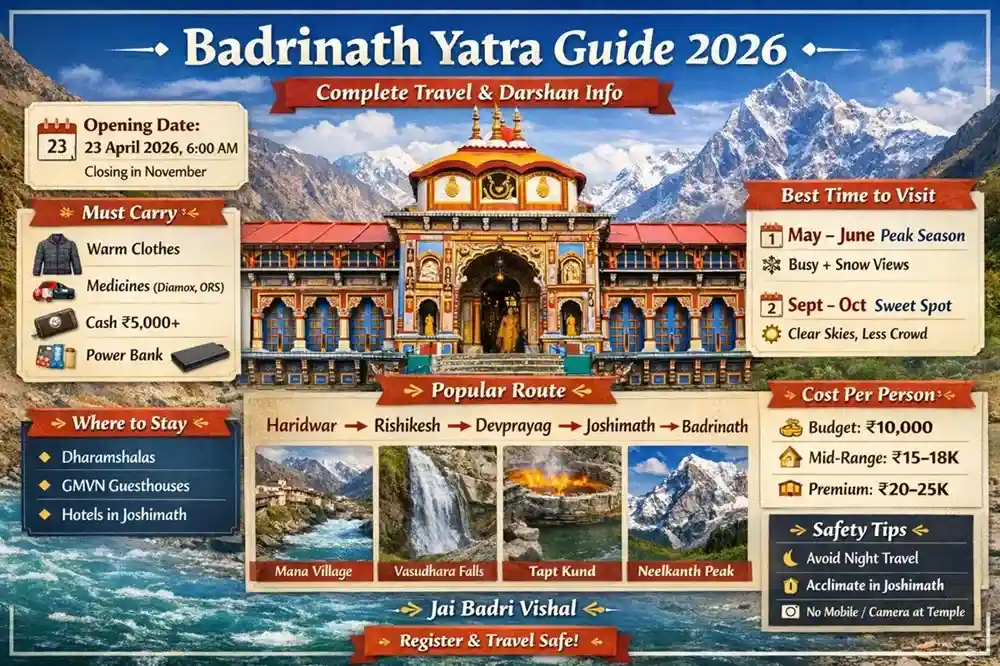
What is Badrinath Dham? Significance and History
Badrinath temple is dedicated to Lord Vishnu and is the only temple in the world that is part of both the Char Dham and the Chota Char Dham (Uttarakhand Char Dham) circuits. It also holds a place in the 108 Divya Desams, the sacred temples of Lord Vishnu.
According to legend, the temple is said to have been established by Adi Shankaracharya in the 9th century. Lord Vishnu meditated here under the Badri tree, with Lakshmi protecting him from the harsh climate — which is why the temple is called Badrinath, the lord of Badri Van (forest of berries).
The Garbha Griha (sanctum sanctorum) houses 15 idols, the most striking being the one-metre tall black stone image of Lord Badrinarayan, finely sculpted in a meditative padmasana (lotus) posture. The canopy above is covered with a sheet of gold, offered by Queen Ahilyabai Holkar.
What most people don’t realize is that Badrinath is considered the last Dham in the Uttarakhand Char Dham Yatra, traditionally done in the order: Yamunotri → Gangotri → Kedarnath → Badrinath.
Badrinath Yatra 2026: Kapat Opening and Closing Dates
The portals of Shri Badrinath Temple are set to open on April 23, 2026, at 6:00 AM. The closing date will be announced later on Vijayadashami. The temple typically opens in the month of April–May and closes for winters in the third week of November.
The opening date of Badrinath Temple is decided every year at the Tehri royal palace during a religious ceremony on the day of Basant Panchami. The ritual process begins with the Gadu Ghada Yatra — an oil container taken from Narendra Nagar — followed by Vedic chanting and the formal opening of the inner sanctum by the head priest.
Important for winter visitors: During winter, worship continues at the Narsingh Temple in Joshimath when Badrinath is closed.
Badrinath Temple Darshan Timings
| Session | Opening Time | Closing Time |
|---|---|---|
| Morning Darshan | 4:30 AM | 1:00 PM |
| Afternoon Break | 1:00 PM | 4:00 PM |
| Evening Darshan | 4:00 PM | 9:00 PM |
The Abhishek Puja and Geeta Path begin at 4:30 AM, followed by public darshan at 6:30 AM. The temple closes at 9:00 PM with the evening aarti.
Pro tip: Arrive by 5:00–5:30 AM if you want to witness the morning aarti without the crowd pressure. On weekends and in peak May–June season, queues can stretch for 2–3 hours.
- Must Read: Special Puja at Badrinath & Kedarnath Dham
Best Time to Visit Badrinath Dham
May to June (Peak Pilgrimage Season)
This is when the temple freshly opens. The roads are accessible, the snow-capped peaks are visible, and the spiritual energy is at its highest. But it’s also the busiest window.
September to Early October (Sweet Spot)
On the ground, many experienced yatris swear by this window. The monsoon crowds have thinned, the skies are clear, and the Himalayas look absolutely stunning. September to October is a second pilgrimage window with favorable weather.
What to avoid: July and August bring heavy rainfall. While the temple remains open during monsoon months, heavy rainfall can lead to landslides and roadblocks, making travel risky.
How to Reach Badrinath: Complete Route Guide
By Road — The Most Popular Route
The route from Haridwar follows: Haridwar → Rishikesh → Devprayag → Srinagar → Rudraprayag → Joshimath → Badrinath. The drive takes around 12–14 hours from Haridwar.
The national route NH-58 connects Delhi to Mana Pass near the Indo-Tibet border, passing through Badrinath. The road is narrow after Joshimath and travel is not permitted after sunset. If you miss the early morning departure from Rishikesh, break the journey at Rudraprayag or Joshimath.
By Air
The nearest airport is Jolly Grant Airport in Dehradun, approximately 318 km from Badrinath. From the airport, you can hire a taxi to reach the Dham.
By Train
The nearest railway station is Haridwar, at a distance of 311 km. Haridwar is well-connected to major North Indian cities. From Haridwar, take a shared jeep, bus, or private taxi.
By Helicopter
Helicopter services operate seasonally from Dehradun’s Sahastradhara helipad to Badrinath — ideal for senior citizens or time-constrained pilgrims. Book well in advance; slots fill fast during peak season.
Badrinath Yatra Cost Breakdown 2026
| Category | Budget Option | Mid-Range | Premium |
|---|---|---|---|
| Accommodation (per night) | ₹500–₹1,500 | ₹2,500–₹5,000 | ₹6,000–₹10,000 |
| Road Travel (bus/jeep) | ₹1,500–₹2,500 | ₹2,500–₹4,000 | — |
| Private Taxi (Rishikesh–Badrinath) | — | ₹2,500–₹5,000 | — |
| Helicopter (one way) | — | — | ₹4,000–₹8,000 |
| Meals (per day) | ₹200–₹400 | ₹500–₹800 | — |
| Full Package (per person) | ₹10,000 | ₹15,000–₹18,000 | ₹20,000–₹25,000 |
The cost of a Badrinath Yatra package varies depending on the duration, mode of travel, and accommodation choice — ranging from ₹10,000 to ₹25,000 per person.
Entry to the temple itself is free. No ticket, no entry fee.
Places to Visit Near Badrinath
Mana Village: Located 3 km from Badrinath, Mana is known as the last Indian village near the Indo-Tibet border. It’s a peaceful and beautiful spot for solo explorers.
Vasudhara Falls: A short trek from Mana Village. The views of snow-capped Himalayan peaks are spectacular. Worth every step.
Tapt Kund: A natural hot water spring right next to the temple. Pilgrims traditionally take a dip here before entering for darshan. Especially welcome on a cold morning at 3,133 metres.
Neelkanth Peak (6,597 m): The towering Neelkanth peak forms a dramatic backdrop behind the temple. Photographers, take note — sunrise from Tapt Kund with Neelkanth in the background is extraordinary.
Panch Badri Circuit: If time permits, the broader Panch Badri yatra covers Vishal Badri (Badrinath), Yog Badri, Bridha Badri, Bhavishya Badri, and Adi Badri — all within Chamoli district.
Accommodation at Badrinath
Rooms fill up quickly during peak season, so it’s smart to book accommodation early.
- Dharamshalas: Most budget-friendly option. Basic but clean. Spiritually immersive.
- GMVN Guesthouses: Government-run, reliable, and good value.
- Mid-range hotels: Hotels like Hotel Dwarikesh and Sarovar Portico provide comfortable stays with basic amenities.
- Ashrams: Some offer free or low-cost stays for pilgrims; prior booking is advisable.
Staying in Joshimath the night before is a popular and smart strategy. Joshimath has plenty of accommodation, food, and market facilities — and Badrinath is just 45 km ahead, a 2-hour drive from there.
Registration: Mandatory for Char Dham Yatra
While registration is mandatory for the full Char Dham Yatra, it is still advisable to register online even if you’re only visiting Badrinath. It helps the government track pilgrims for safety and emergency purposes. You can register through the official Char Dham Yatra portal or at help centers in Rishikesh and Haridwar.
Do this before leaving home. Registration queues at Rishikesh during peak season can be long.
What to Pack for Badrinath Yatra
| Category | Items |
|---|---|
| Clothing | Woolen jacket, thermals, raincoat, warm socks, gloves, muffler |
| Footwear | Waterproof trekking shoes with good grip |
| Medicines | Diamox (altitude sickness), paracetamol, ORS, antacids, personal medicines |
| Documents | Aadhaar card, registration QR code printout, hotel bookings |
| Money | Sufficient cash (₹5,000–₹8,000 minimum in hand) |
| Electronics | Power bank, torch, offline maps downloaded |
| Food | Dry fruits, energy bars, nuts, glucose biscuits for the road |
| Miscellaneous | Reusable water bottle, sunscreen, sunglasses |
ATMs are limited in the region — always carry enough cash, especially when traveling to remote areas like Mana Village. BSNL and Jio offer the best network coverage in Badrinath; keep one of these as your primary SIM.
Things Not to Do on the Badrinath Yatra
Rushing the journey. From practical experience, most problems — altitude sickness, exhaustion, missed darshan — happen when people try to cover Badrinath and Kedarnath in under 4 days. Give yourself at least 7–8 days for a comfortable Char Dham Yatra.
Skipping acclimatization. Since the temple is at high altitude, breathing can be problematic as oxygen levels are low. Give yourself enough time to acclimatize. Spend at least one night at Joshimath before proceeding.
Packing too heavy. Mountain travel is genuinely easier with lighter luggage. A 10–12 kg bag is the practical limit for a smooth yatra.
Ignoring weather forecasts. In real life, the mountains don’t care about your itinerary. One landslide on the Joshimath–Badrinath stretch can delay travel by 6–12 hours. Build buffer days into your plan.
Not checking the phone and camera policy. Pilgrims visiting Badrinath during the Char Dham Yatra 2026 will not be allowed to carry cameras or mobile phones beyond Singhdwar, located around 100 metres before the temple’s sanctum sanctorum. Keep your phone in the locker before proceeding.
Safety Tips for Badrinath Yatra
- Consult your doctor if you have heart conditions or breathing problems — the altitude is above 3,000 metres
- Respect the sanctity of the place by refraining from alcohol and non-vegetarian food in the holy town of Badrinath.
- Avoid night driving on the mountain roads between Joshimath and Badrinath
- Travel in groups when trekking to Vasudhara Falls or Mana
- Keep emergency contact numbers saved — local police, GMVN, and your hotel
Food at Badrinath
Only vegetarian food is available in and around Badrinath. Simple meals like dal, rice, roti, sabzi, Maggi, and tea are easily available. Don’t expect restaurants — expect honest Garhwali dhabas and langar halls near the temple. Carry dry fruits, energy bars, and nuts for the road journey.
Suggested Itinerary for Badrinath Yatra from Haridwar
| Day | Route | Activity |
|---|---|---|
| Day 1 | Haridwar → Rishikesh | Arrive, Ganga Aarti at Triveni Ghat, registration |
| Day 2 | Rishikesh → Rudraprayag | Drive via Devprayag and Srinagar, overnight halt |
| Day 3 | Rudraprayag → Joshimath | Drive via Karnaprayag and Chamoli, overnight at Joshimath |
| Day 4 | Joshimath → Badrinath | Early morning departure, darshan, Tapt Kund |
| Day 5 | Badrinath | Morning aarti, Mana Village, Vasudhara Falls, Brahma Kapal |
| Day 6 | Badrinath → Rudraprayag | Return journey, overnight halt |
| Day 7 | Rudraprayag → Haridwar | Return, yatra complete |
FAQs
Q. Is there an entry fee for Badrinath Temple?
No. There is no entry fee to visit Badrinath Temple; it is open to all devotees free of charge.
Q. Can senior citizens visit Badrinath comfortably?
Yes, with proper planning. It’s advisable to visit during May–June or September, avoid peak cold and monsoon months, and consult a doctor beforehand. Unlike Kedarnath, there is no trek required at Badrinath — the temple is accessible directly by road.
Q. How many days are needed for Badrinath Yatra?
A standalone Badrinath trip can be completed in 3–4 days from Haridwar. For the full Char Dham Yatra, plan 10–14 days comfortably.
Q. Is Badrinath open in 2026?
Yes. The portals of Shri Badrinath Temple are confirmed to open on April 23, 2026.
Q. Which mobile networks work at Badrinath?
BSNL and Jio offer good 4G coverage in Badrinath. Airtel works in parts. Keep BSNL as a backup option.
One Suggested Day Plan at Badrinath
4:30 AM — Wake up, proceed to Tapt Kund for the ritual bath before darshan. The hot spring water is warm and the air is cold — an unforgettable combination.
5:00–6:00 AM — Morning darshan and aarti. This is the quietest and most spiritually powerful window of the entire day. Crowd is minimal.
8:00–10:00 AM — Breakfast at a local dhaba, then proceed to Brahma Kapal for ancestral prayers if applicable.
10:30 AM–1:00 PM — Drive to Mana Village (3 km), visit Vyas Gufa, Bhim Pul, and the mouth of Saraswati river. Begin the trek toward Vasudhara Falls if physically fit.
4:00–6:00 PM — Evening darshan session. If you missed the morning aarti, the evening aarti at 9:00 PM is equally beautiful.
9:00 PM — Evening aarti, then retire to accommodation.
Final Word
The Badrinath Yatra rewards patience. The roads demand respect. The mountains set their own pace. What most pilgrims say after the journey isn’t about the difficulty — it’s about the feeling of standing in front of Lord Badrinarayan at 3,133 metres, with the Neelkanth peak behind and the Alaknanda river below, that stays with them forever.
Register early, book accommodation in advance, leave buffer days, and carry your warm clothes. The rest, the Himalayas will take care of.
🙏 Jai Badri Vishal.
Suggested Tour