Most people who travel to Badrinath Dham come with one agenda — seek darshan of Lord Badrinarayan, take a dip at Tapt Kund, and head back. And there’s nothing wrong with that. The temple alone is worth the entire journey. But here’s the thing: Badrinath is surrounded by some of the most extraordinary places in the Himalayas — mythological caves, a UNESCO World Heritage Site, glacial lakes, hot springs, and a living tribal village that sits at the very edge of India. If you’re already making the journey to Chamoli district of Uttarakhand, you’d be doing yourself a disservice by not exploring the places nearby.
This guide covers the 10 best places to visit near Badrinath Dham — with distances, best time, travel tips, and the kind of on-the-ground detail that actually helps you plan.
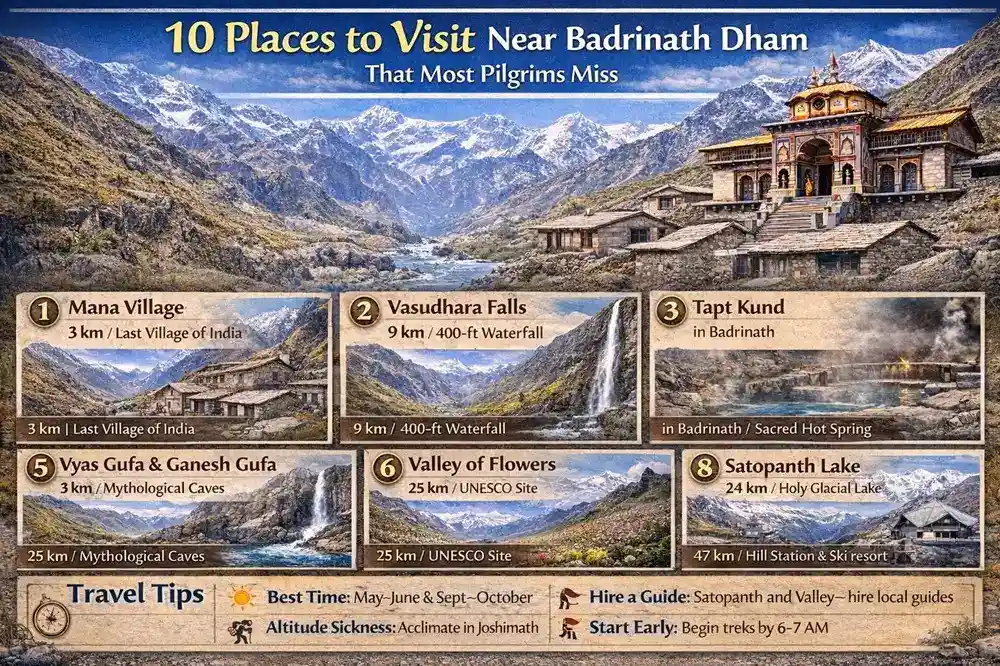
At a Glance
| # | Place | Distance from Badrinath | Type |
|---|---|---|---|
| 1 | Mana Village | ~3 km | Heritage / Mythology |
| 2 | Vasudhara Falls | ~9 km (from Mana) | Nature / Trek |
| 3 | Tapt Kund | Within Badrinath | Hot Spring / Spiritual |
| 4 | Charan Paduka | ~3 km | Pilgrimage / Easy Trek |
| 5 | Vyas Gufa & Ganesh Gufa | ~3 km (in Mana) | Mythology / Cave |
| 6 | Valley of Flowers | ~25 km (via Govindghat) | UNESCO / Trek |
| 7 | Hemkund Sahib | ~25 km (via Govindghat) | Sikh Pilgrimage |
| 8 | Satopanth Lake | ~24 km | High-altitude Trek |
| 9 | Joshimath (Auli) | ~47 km | Hill Station / Skiing |
| 10 | Brahma Kapal | ~2 km | Ancestral Rituals |
1. Mana Village — The First Village of India
If there’s one place you absolutely cannot skip after Badrinath darshan, it’s Mana. Located just 3–4 km north of the temple, Mana is officially designated as India’s “First Village” — a rebranding by the Uttarakhand government from its older title, “Last Village before Tibet.”
The village sits at around 3,200 metres (10,500 feet) above sea level and is home to the Bhotiya tribe — specifically the Marchha and Jad clans — whose semi-nomadic lifestyle has made them the cultural gatekeepers of this Himalayan frontier for centuries.
What makes Mana genuinely different from any tourist spot you’ve visited: it feels lived-in. Women weave wool carpets outside their stone homes. Kids run between centuries-old lanes. The famous Last Tea Stall of India serves hot chai at completely normal prices. And just a short walk beyond the stalls sits the Saraswati River — audible long before you see it — which disappears underground here before meeting the Alaknanda at Keshav Prayag nearby.
Best time: May–June & September–October How to reach: 10-minute drive or 30-minute walk from Badrinath temple Entry fee: None
2. Vasudhara Falls — A Waterfall That Judges You
This one sounds dramatic, but locals genuinely believe it. Vasudhara Falls — a stunning 400-feet cascade — is located about 9 km from Mana Village, making it roughly 12–13 km from Badrinath. The trek to reach it is one of the most rewarding easy-to-moderate walks in the region.
The waterfall pours down in a fine misty spray from a cliff on the Mana plateau, and the legend associated with it is fascinating: the water is said to avoid falling on anyone with a troubled conscience. Whether or not you believe that, the sight of it is striking enough without the mythology.
The trail from Mana passes through grassy alpine meadows, offers views of the Saraswati River, and passes a Saraswati Devi temple along the way. Most people do this as a half-day trek from Badrinath.
Distance from Badrinath: ~12–13 km total Trek difficulty: Easy to moderate Time required: 4–5 hours (round trip from Mana) Best time: May–June, September–October
3. Tapt Kund — The Hot Spring That Greets Every Pilgrim
Technically within the Badrinath complex itself — right beside the Alaknanda River — Tapt Kund is one of those places where mythology and natural science meet in the most unlikely way. The spring heats up to roughly 45 degrees Celsius, and every pilgrim visiting Badrinath is expected to take a dip here before entering the main temple.
The water is locally believed to have medicinal properties, especially for skin ailments. In the middle of Himalayan cold, stepping into those warm waters is an experience that’s hard to describe unless you’ve done it. In winter, when the region is buried in snow and temperatures plunge well below zero, this spring never freezes — which explains why it’s been considered sacred for thousands of years.
Just next to it is Narad Kund, a smaller hot water tank where Adi Shankaracharya is believed to have recovered the original idol of Lord Vishnu. Don’t miss it — most pilgrims rush past.
Location: Within Badrinath Dham area Entry fee: None Best time: Any time during the open season (May–November)
4. Charan Paduka — Vishnu’s Footprints on the Mountain
Located at 3,380 feet elevation, about 3 km from Badrinath, Charan Paduka is a large boulder with imprints that Hindus believe are the divine footprints of Lord Vishnu — made when he first descended to Earth from his celestial abode, Vaikunth.
The approach is an uphill trek that takes about 45 minutes to an hour. It’s not technically difficult, but the altitude makes it feel more strenuous than it would at sea level. What the trek rewards you with, beyond the religious significance, is a sweeping panoramic view of the Badrinath valley and the surrounding Himalayan peaks.
Most pilgrims overlook this because they’re focused on the main temple. On the ground, that means Charan Paduka is far quieter and more contemplative than the Badrinath temple premises on a busy day. Good place to take a breath.
Distance from Badrinath: 3 km Trek time: 45 minutes – 1 hour (one way) Difficulty: Easy
5. Vyas Gufa & Ganesh Gufa — Where the Mahabharata Was Born
Both caves are inside Mana Village, roughly 3 km from Badrinath. But they deserve their own mention because they’re genuinely extraordinary from a mythological standpoint.
Vyas Gufa is the cave where Maharishi Ved Vyas is believed to have dictated the entire Mahabharata to Lord Ganesha — one of the most significant acts of literary and spiritual creation in human history, if the legend is taken seriously. The cave has a small shrine inside, and the roof has a natural formation that resembles stacked pages of a manuscript — a detail that local guides always point out.
Ganesh Gufa, a short walk away, is where Ganesha sat and wrote as Vyas dictated. It’s smaller, quieter, and somehow even more atmospheric than Vyas Gufa. A Ganesha idol sits inside, and the surrounding meadows are genuinely beautiful.
What most people don’t realise: both caves are free to enter, take no more than 20 minutes each, and are a five-minute walk from one another. There’s no good reason to miss either.
Location: Mana Village, 3 km from Badrinath Entry fee: None Time required: 30–45 minutes for both
6. Valley of Flowers — A UNESCO World Heritage Site Near Badrinath
This is where Badrinath pilgrimage territory and world-class trekking overlap. The Valley of Flowers is situated at an altitude of 3,658 m in the Bhyundar valley in Chamoli district of Uttarakhand. It is part of the Nanda Devi Biosphere Zone and holds UNESCO World Heritage Site status. The park spans roughly 87 square kilometres and is home to over 520 species of alpine plants.
The base for this trek is Govindghat, which is about 25 km from Badrinath on the way back toward Joshimath. From Govindghat, you trek to Ghangaria (9 km), then to the valley itself (another 6 km). It’s a multi-day commitment, not a day trip.
The best part? The valley is famous for its wide variety of flora — Alpine flowers, Vajardanti, Marsh Marigold — and fauna that includes the Asiatic black deer, snow leopard, musk deer, red fox, brown bear, blue sheep.
Distance from Badrinath: ~25 km (via Govindghat) Trek distance (total round trip): ~38 km Best time to visit: Mid-July to mid-September (peak bloom) Difficulty: Easy to moderate Entry fee: National park fee applies
| Trek Segment | Distance | Time |
|---|---|---|
| Govindghat to Pulna (drive) | 4 km | 15 min |
| Pulna to Ghangaria (trek) | 9 km | 4–5 hours |
| Ghangaria to Valley of Flowers | 6 km (one way) | 3–4 hours |
7. Hemkund Sahib — The World’s Highest Gurudwara
Paired almost always with the Valley of Flowers trek, Hemkund Sahib is the highest Gurudwara in the world, sitting at an elevation of approximately 4,329 metres (14,100 feet). The trek starts from Ghangaria — the same base camp as Valley of Flowers — and covers about 6 km each way, taking 7–9 hours for the round trip.
The Gurudwara sits beside a perfectly still glacial lake that reflects the surrounding Saptarishi Peaks during clear skies. The pilgrimage destination is devoted to the 10th Sikh Guru Gobind Singh and has found its mention in Dasam Granth, dictated by the Guruji himself. Near the Gurudwara, there is also a Laxman Temple — adding a Hindu pilgrimage dimension alongside the Sikh significance.
On the ground: the ascent to Hemkund Sahib is steep and relentless. Even experienced trekkers find the last stretch punishing at altitude. The descent is faster but equally hard on the knees. Start early.
Elevation: 4,329 m (14,100 ft) Distance from Ghangaria: 6 km one way Best time: June–October Difficulty: Moderate to challenging
8. Satopanth Lake — The Trinity’s Sacred Lake
If Valley of Flowers is accessible trekking, Satopanth Lake is the serious high-altitude version. Located about 24 km from Mana Village (roughly 27 km from Badrinath), the lake sits at an elevation of approximately 4,600 metres (15,100 feet) and is considered one of the most sacred glacial lakes in India.
The lake is triangular in shape, and local Hindu belief holds that Lord Brahma meditates at one corner, Lord Vishnu at another, and Lord Shiva at the third — hence the name “Satopanth” (path of truth/virtue). The trek typically takes two days with an overnight camp near Chakrateerth.
This is not a casual day trip. It requires proper trekking gear, acclimatisation, and ideally a guide. The route passes through glacial moraines, rocky terrain, and offers dramatic views of peaks including Chaukhamba and Neelkanth.
Elevation: ~4,600 m (15,100 ft) Distance from Mana: ~24 km one way Trek duration: 2 days Best time: May–June, September–October Difficulty: Challenging
9. Joshimath and Auli — Gateway Town with a World-Class Ski Slope
About 47 km from Badrinath on the return road, Joshimath isn’t just a transit point — it’s a destination in itself. Sitting at 1,890 metres, it’s the winter seat of Lord Badrinath (the idol is shifted to the Narsingh Temple here when Badrinath closes), and it holds deep religious significance as the town where Adi Shankaracharya established one of his four mathas (monasteries) in the 8th century.
Tourists can also visit the Narsingh and Kalpavriksha temples while travelling to Joshimath, including the sacred wish-fulfilling tree Kalpavriksha said to be more than 1,000 years old.
Just 14 km from Joshimath is Auli — India’s premier skiing and paragliding destination, sitting at 3,050 metres. Auli is one of India’s top skiing destinations, reachable by a thrilling ropeway ride or by road, with skiing down snow-covered slopes offering stunning views of the surrounding mountains. The ropeway connecting Joshimath to Auli is one of the longest cable cars in Asia.
Auli is ideal in winter (January–March) for skiing and in summer (May–June) for paragliding and meadow views.
Distance from Badrinath: ~47 km Best time: Winter (ski season: January–March), Summer (May–June)
10. Brahma Kapal — Where Ancestors Receive Liberation
This one is not on most tourist lists. But for pilgrims, Brahma Kapal is one of the most important stops in all of Badrinath. Located just 2 km from Badrinath temple, on the banks of the Alaknanda River, it is the place where Hindus come to perform pind daan — the ancestral ritual offering for the souls of deceased family members.
People come to Brahma Kapal to immerse the ashes of their deceased family members in the Alaknanda River, and it is believed that if funeral rituals take place at this holy site, the deceased is bound to attain salvation. It is considered one of the most powerful sites for pitru tarpan (ancestral oblations) in all of India.
Even if you don’t have a specific religious purpose, visiting Brahma Kapal and watching the quiet rituals unfolding on the riverbank at dawn or dusk is one of those unexpectedly moving experiences that Badrinath offers beyond the main temple.
Distance from Badrinath: ~2 km Entry fee: None Best time: Any time during open season
Best Time to Visit Places Near Badrinath Dham
| Season | Months | Conditions | Recommended For |
|---|---|---|---|
| Early Summer | May–June | Pleasant, 10–20°C, clear roads | All 10 places on this list |
| Monsoon | July–August | Landslide risk, heavy rain | Valley of Flowers (peak bloom) only |
| Post-Monsoon | September–October | Crystal clear skies, cool | Most places, fewer crowds |
| Winter | November–April | Village closed, roads blocked | Not advisable |
The sweetest window is May–June or September–October. If Valley of Flowers is your priority, aim for July–August but accept the landslide risk on the Joshimath–Badrinath road.
Practical Travel Tips
- Acclimatise at Joshimath (1,890 m) for at least one night before pushing to Badrinath (3,133 m). Altitude sickness is real and ruins trips.
- Carry cash. The last reliable ATM is in Joshimath or Pipalkoti. Nothing in Mana, Vasudhara, or Satopanth.
- BSNL gives the best mobile coverage in the region. Jio and Airtel work intermittently above Joshimath.
- Start valley and waterfall treks early — by 6 or 7 AM. Weather at high altitude deteriorates in afternoons, especially in monsoon season.
- Hire a local guide for Satopanth Lake — the route is remote and the altitude is serious.
- Dress in layers. Even in May and June, mornings and evenings at Badrinath altitude are genuinely cold.
- Vasudhara Falls and Mana can be done in one day — start at Mana at 7 AM, reach Vasudhara by 10 AM, return to Badrinath by 2 PM comfortably.
Common Mistakes to Avoid
- Trying to do Valley of Flowers as a day trip from Badrinath — it’s a multi-day trek with a different base. Set aside 3–5 days minimum.
- Skipping Mana Village and heading straight back — it’s 3 km from the temple. There’s no excuse not to go.
- Underestimating Satopanth Lake — it’s 24 km one way at high altitude. Not a casual afternoon walk.
- Going in July–August without checking road conditions — landslides between Joshimath and Badrinath are common and can block routes for days.
- Forgetting entry permits for Valley of Flowers — it’s a national park. Permits are required and checked at the entry point near Ghangaria.
FAQs: Places Near Badrinath Dham
Q-1: How many days are needed to cover all places near Badrinath?
Ans: A minimum of 5–6 days is needed to cover the main attractions comfortably — 1 day for Badrinath darshan + Tapt Kund + Brahma Kapal, 1 day for Mana + Vasudhara, 3 days for Valley of Flowers + Hemkund Sahib, and 1 day for Joshimath/Auli. Satopanth Lake requires an additional 2 days.
Q-2: Is Valley of Flowers accessible from Badrinath?
Ans: Yes. Govindghat — the base for Valley of Flowers — is about 25 km from Badrinath on the Joshimath road. Many travellers visit Badrinath first, then make their way back to Govindghat for the valley trek.
Q-3: Which place near Badrinath is best for first-time visitors?
Ans: Mana Village, Vyas Gufa, Bheem Pul, and Vasudhara Falls are all ideal for first-timers — accessible, deeply interesting, and not technically demanding.
Q-4: Is Hemkund Sahib open throughout the year?
Ans: No. Hemkund Sahib typically opens in late May/June and closes by mid-October. It’s inaccessible in winter due to heavy snowfall at 4,329 metres.
Q-5: Can I visit Charan Paduka without a guide?
Ans: Yes. The 3 km trail from Badrinath is clearly marked and regularly used. No guide is needed, but good walking shoes are essential.
Final Word
Badrinath Dham is one of India’s most sacred shrines — but the landscape around it is among the richest in the entire Himalayan range. The mythology runs deep, the trekking is world-class, and the natural beauty is the kind that makes people genuinely quiet when they encounter it.
Whether you’re a pilgrim who wants to explore beyond the main temple, a trekker who wants to combine Char Dham with serious Himalayan walking, or a traveller simply looking for something real — the places to visit near Badrinath Dham will reward every kind of intention. Just plan right, go at the right time, and don’t rush it.